HVAC Upgrade for Fishn' Pier Grill in Stone Harbor, NJ
May 14, 2026 · 6 min read · Rich Wellamaro
Fishn' Pier Grill at the Liberty Building in Stone Harbor, NJ needed a dependable HVAC system before summer traffic picked up along the shore. The existing equipment was no longer keeping up. Budd's Plumbing | Heating | Cooling completed a multi-day upgrade in May 2026 that included two separate systems, custom insulated ductwork, condenser replacement, gas piping, roof venting, and full startup and commissioning before the space was handed back.
The Comfort Challenge
Restaurants put more demand on HVAC systems than most residential properties. Kitchen heat, full dining rooms, fluctuating occupancy, and exposure on a shore property all add pressure. In a grill and dining environment, cooling has to reach the right zones — guests at a table near the front wall experience the space differently than staff working closer to the kitchen. The existing equipment at Fishn' Pier Grill was no longer sized or positioned to handle that load effectively, and with summer approaching, the window for a planned replacement was narrow.
Need help with HVAC replacement? We’re ready.
Serving Cape May County and Atlantic County, NJ. Licensed, local, and available now.
Removing Old Equipment and Planning the New Layout
The crew began by removing the existing 4-ton air handler system, ductwork, and plenum — clearing the space to plan the new layout correctly. Getting equipment in and out of the Liberty Building required careful coordination: a section of the back banister was removed to safely move the condensers using a lift. Once the old system was out and access was confirmed, installation of the new equipment proceeded.
Removed existing 4-ton air handler, ductwork, and plenum
Coordinated equipment access and removal through the building using a lift
Installed new Ruud 5-ton Endeavor Line two-stage air handler (RH2TY)
Installed Ruud 70,000 BTU natural gas furnace (R962V0703A17M4SC) with matching 2.5-ton evaporator coil
Ran new gas line from the meter to the furnace
Installed vent piping through the roof with proper flashing
Custom Ductwork Above the Dining Area
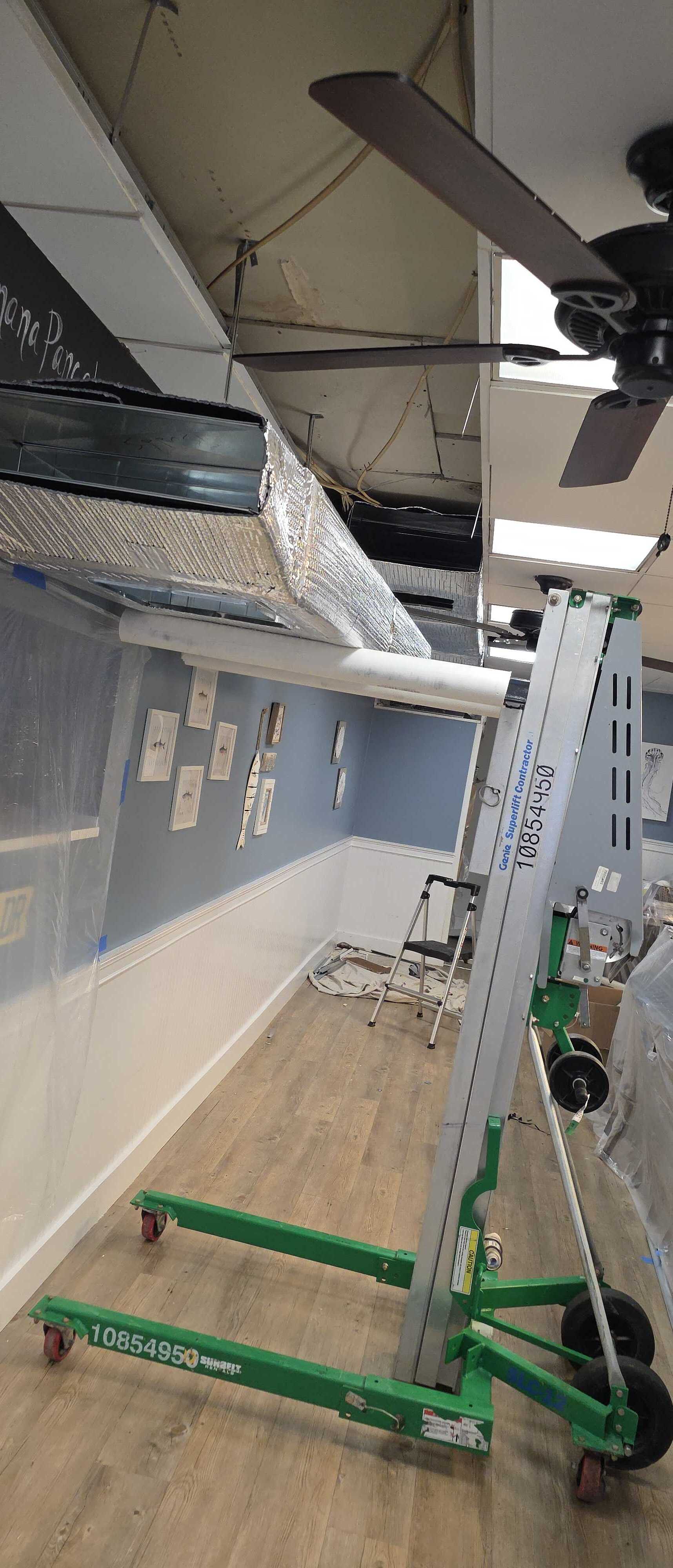
One of the most visible parts of this project was the custom insulated trunk line fabricated and installed above the dining area. Budd's built, wrapped, hung, and connected the new ductwork to support three to four diffusers positioned toward the front wall of the dining and grill area. The goal was to push conditioned air where guests actually sit — improving comfort on hot summer days and providing supplemental heat when temperatures drop.
Custom insulated ductwork installed above the dining and grill area during the Stone Harbor HVAC upgrade.
Two HVAC Systems Working Together
The upgrade installed two independent HVAC systems to serve different zones of the space. Each system has its own thermostat, giving staff separate control over each area.
System 1 — Main dining area: Ruud 5-ton Endeavor Line two-stage air handler paired with an RD18AY side-discharge heat pump (18 SEER2). Serves the custom ductwork installed above the dining and grill area.
System 2 — Opposing zone: Ruud 70,000 BTU natural gas furnace with a matching 2.5-ton evaporator coil and RA14AY30AJ1NA condenser (14.3 SEER2). Provides dedicated heating and cooling for the other side of the space.
Controls: Two simple thermostats installed — one per system — for independent zone management.
Outdoor Condensers, Line Sets, and Electrical Protection
Both condensers were set outdoors and both line sets were flushed and connected. The team pressure-tested each line set — leaving one system under a 400 PSI nitrogen pressure test — then fully evacuated both before startup. The existing 220V condenser service disconnects were replaced with fused disconnects and surge protectors, a practical safeguard at a shore property where electrical irregularities are common.
Outdoor condenser units set at Fishn' Pier Grill with new fused disconnects and surge protection.
Startup, Testing, and Final Verification
On May 11, with both systems fully installed, the Budd's crew completed startup and commissioning. Each system was started and run in both heating and cooling modes. Technicians verified controls, checked temperatures and airflow at each diffuser, and confirmed both systems were operating correctly before departure. The space was fully operational and ready for normal use.
Planning an HVAC Upgrade for a Restaurant or Local Business?
Projects like this one require more planning time than a standard residential replacement. Equipment access, custom ductwork, gas piping, roof penetrations, condenser placement, and multi-zone controls all need to be worked out before work begins. If you own or manage a commercial or light-commercial property in Cape May County or Atlantic County and your HVAC system is aging or underperforming, the time to plan a replacement is before peak seasonal demand — not during it.
Common signs include uneven comfort across seating areas, equipment that struggles during peak summer or winter weather, aging units past their expected service life, airflow problems, or significant layout and service changes in the space. A professional evaluation helps identify whether repair or replacement makes more sense for your property.
Ductwork determines where conditioned air reaches. In a restaurant, the seating layout, kitchen heat load, ceiling configuration, and diffuser placement all affect how evenly air is distributed. Custom ductwork sized and routed for the specific space performs better than components that may not fit the layout or airflow requirements of the building.
After installation, technicians start each system and test both heating and cooling modes. They verify that controls respond correctly, check temperatures and airflow, and confirm the equipment is operating correctly before leaving the job. On this project, both systems were fully tested in heating and cooling modes before the crew departed.
Related Services
More from Budd’s
Furnace Installation
Plan a high-efficiency gas furnace replacement before the heating season starts.
.avif)
.avif)